

DOP 4: Draw One Part
SayGames Ltd
Some puzzle games ask me to plan several moves ahead, while others are really about noticing what is missing. DOP 4: Draw One Part belongs to the second group, but it gives that familiar idea a distinct feel: each stage presents a simple drawing with a missing piece, and I have to sketch the shape that completes it. The appeal is immediate because the task is easy to understand, yet the correct answer often depends on seeing the picture as a whole rather than staring at the empty space.
After spending time with it, I found a game that works best in short, relaxed sessions. It is a free puzzle game from SayGames Ltd, rated Everyone 10+, and it has become a very visible title in its category, with an average rating of 4.5 from around 280 thousand ratings and over 100 million installs. Those figures make sense to me: the basic idea is approachable, the rounds are quick, and the visual presentation is friendly enough for casual play.
How DOP 4 turns a missing detail into a playable mood
A first impression built around curiosity
The first thing I noticed was how little explanation the game needs. I am shown an incomplete illustration, and the goal is not to select from a menu of answers or arrange a collection of tiles. I draw the missing part directly on the screen. That physical action gives the puzzle a more personal quality than a standard tap-to-match challenge, even though the underlying task remains simple.
Related News
The opening experience is intentionally light. There is no need to learn a complicated interface, memorize rules, or understand a large fictional setting before playing. The drawing itself is the setting. A partly finished object creates a tiny question in my mind: what belongs here, and what shape would make the image feel complete? That question supplies enough tension for a short round without making the game feel demanding.
I also like that the game does not require artistic talent in the usual sense. My sketches do not need to look beautiful. What matters is whether the gesture communicates the missing object or feature. This is an important distinction for anyone who might avoid a drawing game because they cannot draw well. The challenge is visual reasoning, not producing polished artwork.
Related News

Why WhatsApp Messenger Still Makes Everyday Communication Feel Easy

Jurassic World: The Game Is the Better Dino Tycoon for Strategic Players

Threads in Real Life: Who Should Join, Lurk, or Leave

How SHEIN Turned Shopping Into an Endless Content Feed

How to Make Fortnite Feel Smarter on Mobile

Should You Switch to Microsoft Outlook on Mobile?
That said, the simplicity can make the early experience feel almost too gentle for players who want immediate complexity. If you prefer dense logic grids, difficult number puzzles, or long strategic chains, the first impression may seem closer to a playful brainteaser collection than a serious puzzle campaign. I see that as a deliberate choice rather than a flaw, but it clearly defines the audience.
A visual language that explains the rules without speeches
The art direction does a lot of practical work. The scenes are presented as readable illustrations, so the missing element is usually understood through context. A line, object, facial detail, or environmental feature can change the meaning of the entire picture. Instead of giving me a paragraph of instructions, the composition points toward the answer.
This visual language is one of the strongest parts of the experience because it keeps the puzzle and the presentation connected. The artwork is not merely decoration placed behind a mechanic. It is the clue system. I have to read the drawing, identify its visual grammar, and then add a mark that belongs there. When the answer becomes obvious, the satisfaction comes from recognizing the scene rather than from performing a difficult swipe.
Gallery
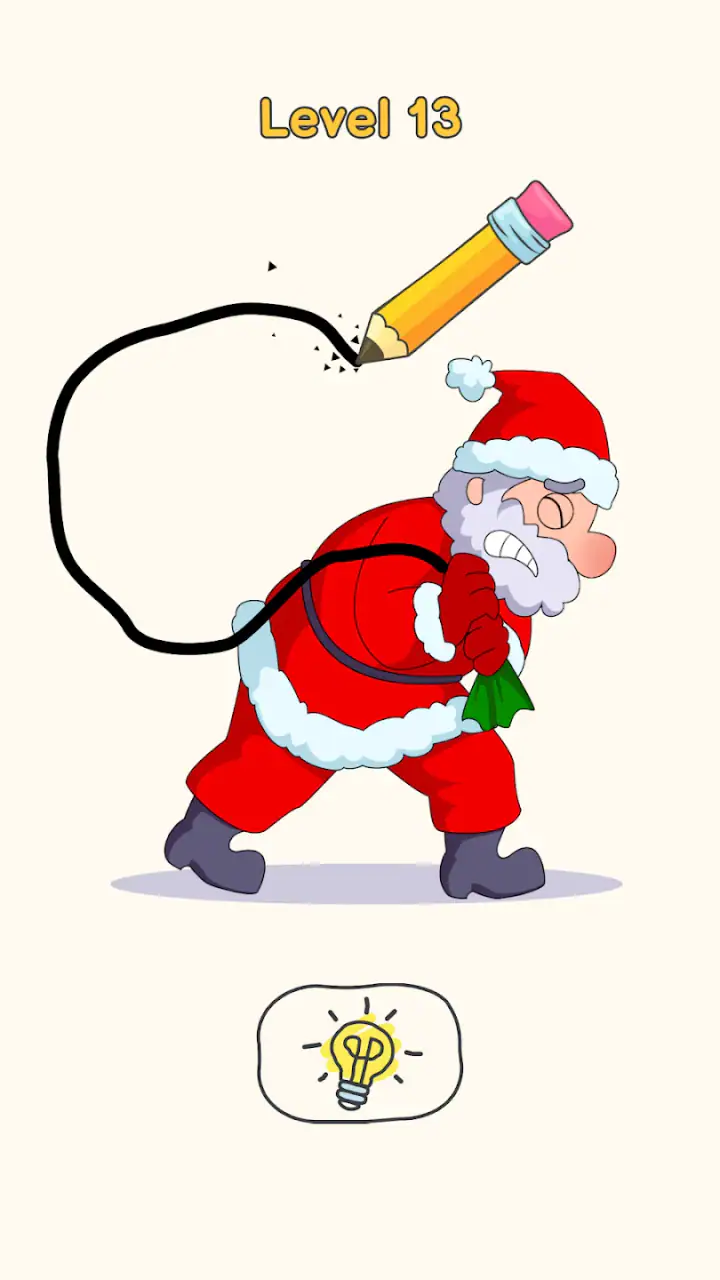
The clean, cartoon-like presentation also supports the game’s gentle mood. There is little visual clutter competing with the central image, which matters on a phone where a crowded screen can make a small puzzle feel tiring. The illustrations are approachable, and their simplicity leaves room for the missing detail to stand out.
One useful habit is to stop looking only at the blank area. When I get stuck, I examine the surrounding lines, the direction of nearby objects, and the balance of the whole image. A missing piece may not be represented by a faint outline. The clue can be indirect, such as symmetry, a visual pattern, or the expected continuation of an object. This makes the game more interesting than simply tracing a visible gap.
The trade-off is that visual interpretation can sometimes feel subjective. A player may understand what the scene needs but draw it in a way the game does not recognize immediately. That can create a moment of friction, especially when the intended answer seems obvious from the illustration but the successful stroke requires a particular approximation. I found it best to make a simple, confident mark instead of repeatedly scribbling over the same area.
Sound and rhythm keep the puzzles moving
The audio contributes to the game’s atmosphere without becoming the main attraction. In my experience, the sound design works as a gentle confirmation system: actions feel acknowledged, solutions feel complete, and the transition between small challenges maintains momentum. It supports the playful tone rather than trying to create drama that the puzzles do not need.
This restrained approach suits the format. A puzzle that lasts only a short time benefits from a clear rhythm: inspect, draw, receive feedback, and move on. The sound helps separate those moments, giving each solution a small sense of closure. I never felt that the audio was asking me to take the scene more seriously than necessary.
For longer sessions, however, the same rhythm can become repetitive. This is a game I would happily play while waiting for an appointment or during a spare break, but I would not choose it primarily for an expansive soundscape. People who want atmospheric music, elaborate storytelling, or a strong emotional soundtrack should look toward a different kind of puzzle game. Here, sound is functional and mood-setting rather than a feature that carries the experience.
That makes the title particularly suitable for casual use. I can focus on the image, play several rounds, and stop without feeling that I have abandoned a complicated narrative. The pacing respects interruptions. If a message arrives or I need to put my phone down, I am not losing a long chain of strategic planning.
The rhythm also affects how I approach difficulty. Because the rounds are compact, I am more willing to try an unusual interpretation instead of overthinking it. I can test a small line, observe the response, and adjust my idea. This trial-and-observation loop is one of the game’s quiet strengths, although players who dislike experimentation may prefer puzzles with more explicit rules and predictable outcomes.
Why the drawing mechanic fits the artwork
The central mechanic succeeds because it matches the way the scenes are designed. I am not solving an abstract problem and then receiving a random reward. I am completing a picture with a gesture that resembles the missing object. That connection makes the action feel natural. The game asks me to think visually, and it lets me answer visually.
There is also a useful difference between knowing the answer and expressing it. I may recognize that a scene needs a particular item, but I still have to draw a recognizable version of it. This gives the puzzle a small layer of execution without turning it into a precision drawing challenge. The best solutions are usually economical: one clear shape, placed where it makes sense, is more effective than a detailed sketch.
When I play, I use a three-step method. First, I describe the scene to myself in plain language, such as “an object is missing from the person’s hand” or “the pattern stops before the edge.” Second, I look for visual relationships: symmetry, continuation, scale, and direction. Third, I draw the smallest mark that completes that relationship. This approach is more reliable than drawing whatever comes to mind first.
Another non-obvious strength is how the mechanic encourages flexible thinking. The expected solution may be a simple object, but the real challenge is understanding the role that object plays in the illustration. A line might represent a boundary in one scene and a physical item in another. I found myself switching between literal and contextual interpretations, which gives the otherwise modest puzzles more variety.
Still, this is not a deep logic system in the same sense as a traditional deduction game. The stages are built around recognition and visual completion, so players seeking layered rules, resource management, or multi-step planning may run out of intellectual resistance sooner. The game is better at delivering frequent moments of “I see it now” than at demanding extended concentration.
The free entry point helps make that format easy to try. The game costs nothing to download, while optional in-app purchases range from $0.99 to $24.99 per item. I would approach those purchases with a little care and decide beforehand whether I want to spend money on convenience or extras. The core appeal is the act of solving the drawings, so anyone trying to keep the experience simple can start without treating the purchase system as part of the puzzle itself.
Where it fits among familiar puzzle alternatives
Compared with match-three games, this title is less about building combinations and more about interpreting a scene. There is no need to wait for a board to produce a useful arrangement. Compared with word puzzles, it removes spelling and vocabulary from the equation. Compared with classic jigsaw games, it does not ask me to assemble many pieces; it asks me to understand one missing idea.
That makes it a good choice for people who enjoy visual riddles but do not want a long session. It also works well for families with different levels of puzzle experience, provided the age rating is appropriate for the players. An older child can suggest what the picture needs, while an adult can discuss why a particular line or shape completes the scene. The game’s visual communication makes that kind of shared play easy.
I would choose another option if I wanted a persistent world, a carefully developed story, or a puzzle system that rewards planning several stages in advance. I would also look elsewhere if I wanted to practice actual drawing technique. The game uses drawing as an input language, not as a lesson in proportion, shading, or illustration.
It is also worth considering your tolerance for repeated short-form feedback. The structure is designed around many small successes, and that is exactly why it feels accessible. But if you prefer fewer puzzles with substantial depth, the quick cycle may feel lightweight. In my view, the right expectation is a pocket-sized collection of visual challenges, not a full-length logic adventure.
Practical details that affect the decision
The game was released on December 14, 2021, and the current version is 1.1.58. It requires Android 8.0 or later, so most compatible Android users should find the technical entry requirement straightforward, though anyone using an older device should check the operating system before trying to install it.
The age rating is Everyone 10+, which places it in a generally accessible space while still signaling that it is not aimed exclusively at very young children. I would still use personal judgment for younger players, especially because the challenge is based on interpreting images and because the best experience depends on being comfortable with trial and error.
One practical question is whether the game suits offline moments or whether it should be treated as a connected experience. I would not make a firm assumption about that from the puzzle design alone. What I can say is that its short stages make it naturally suited to commutes, queues, and brief pauses, where I want a self-contained activity rather than a game that demands a long uninterrupted session.
Another question is whether a player can enjoy it without spending money. Yes, the free download makes it easy to begin and judge the core mechanic for yourself. The presence of optional purchases means I would pay attention to the purchase flow, but I would not let that stop me from trying the game if the draw-one-part concept appeals to me.
The everyday situations where it works best
My favorite use case is a ten-minute gap that is too short for a film, too long to waste, and not suitable for a demanding game. I can open the app, solve a handful of drawings, and close it without needing to remember a complicated objective. The visual focus is also useful when I want something more engaging than scrolling but less intense than competitive play.
It can work as a conversation starter as well. When two people disagree about what a picture needs, the disagreement is usually brief and playful because the answer is represented by a drawing rather than a long explanation. That gives the game a social quality even though it is designed for individual interaction with the screen.
For a child near the lower end of the age range, I would play alongside them at first. The game can encourage observation and creative problem-solving, but the difference between a sensible answer and a recognized input may not always be clear to a younger player. A little guidance can turn frustration into a useful lesson about looking at the whole image instead of repeatedly marking the same spot.
For adults, the strongest benefit is mental reset rather than serious training. I would not claim that a few rounds replace a structured brain-training routine. Instead, I see it as a pleasant way to shift attention, exercise visual association, and enjoy quick moments of completion during an otherwise ordinary day.
My final atmosphere verdict
DOP 4: Draw One Part creates a coherent mood by keeping its art, sound, pacing, and mechanic pointed in the same direction. The illustrations invite curiosity, the audio gives each action a soft sense of completion, and the short rounds prevent the experience from becoming heavy. Most importantly, drawing is not an unrelated gimmick: it is the natural response to a world made from incomplete pictures.
Its limitations are equally clear. The puzzles are not designed for players who demand elaborate deduction, deep progression, or a rich narrative setting. Some answers may require a particular interpretation or a simple enough stroke for the game to recognize. The light rhythm can also feel repetitive during extended play. Those are real compromises, but they are connected to the same accessibility that makes the game easy to pick up.
I recommend it to anyone who likes visual puzzles, wants a free casual game for short breaks, or enjoys the satisfaction of completing an illustration with a quick gesture. I would skip it if my priority were serious strategic depth or genuine drawing instruction. For the right player, though, the modest idea is well matched to the presentation: the atmosphere never overwhelms the puzzle, and the puzzle gives the atmosphere a reason to exist.
SayGames Ltd has shaped the experience around a simple question and a tactile answer. That is why I can return to it without preparing myself for a major commitment. I open a scene, look for the missing visual language, draw what seems to belong, and let the game’s gentle rhythm carry me to the next small mystery.
FAQs for DOP 4: Draw One Part
What is the main objective of DOP 4: Draw One Part?
DOP 4: Draw One Part is a puzzle game that challenges players to think creatively by drawing missing parts of various pictures. The game provides an incomplete image, and players must use their imagination and drawing skills to complete the picture. It's designed to test both your creativity and problem-solving abilities in a fun and engaging way.
Is DOP 4: Draw One Part suitable for all ages?
Yes, DOP 4: Draw One Part is suitable for players of all ages. Its simple mechanics make it accessible to children, while the increasingly challenging puzzles keep it engaging for adults. The game is family-friendly, and its content is appropriate for everyone, making it a great choice for parents looking for a game that everyone can enjoy.
Are there any in-app purchases in DOP 4: Draw One Part?
DOP 4: Draw One Part is free to download and play, but it does offer in-app purchases. These purchases can include hints or additional content that can enhance the gameplay experience. While the game can be enjoyed without spending money, purchasing hints might help players who find themselves stuck on particularly challenging puzzles.
Does DOP 4: Draw One Part require an internet connection?
DOP 4: Draw One Part can be played offline, making it a great option for those who want to enjoy the game without needing an internet connection. However, some features, like in-app purchases or updates, may require connectivity. Overall, the offline capability ensures you can play anytime, anywhere.
How does DOP 4: Draw One Part handle user data and privacy?
DOP 4: Draw One Part takes user privacy seriously and complies with standard data protection regulations. The game may collect data for performance analytics and to improve user experience, but it doesn't share personal information with third parties without consent. Always check the privacy policy for detailed information on data handling practices.
Pros
- Engaging puzzles keep users entertained.
- Simple controls make it easy to play.
- Regular updates add new levels.
- Visually appealing graphics and design.
- Suitable for all ages
- family-friendly.
Cons
- Ads can interrupt gameplay frequently.
- Some levels may feel too easy.
- Limited hints can be frustrating.
- In-app purchases can be costly.
- Requires internet for some features.


